Punch, the upright-running macaque, and the neuroscience of adaptation
How a bipedal macaque reveals the brains ability to improvise

Hello Readers:
Brains are designed not just to execute inherited behaviors—they are designed to invent new ones when circumstances change. Sometimes, those inventions appear in the most surprising places.
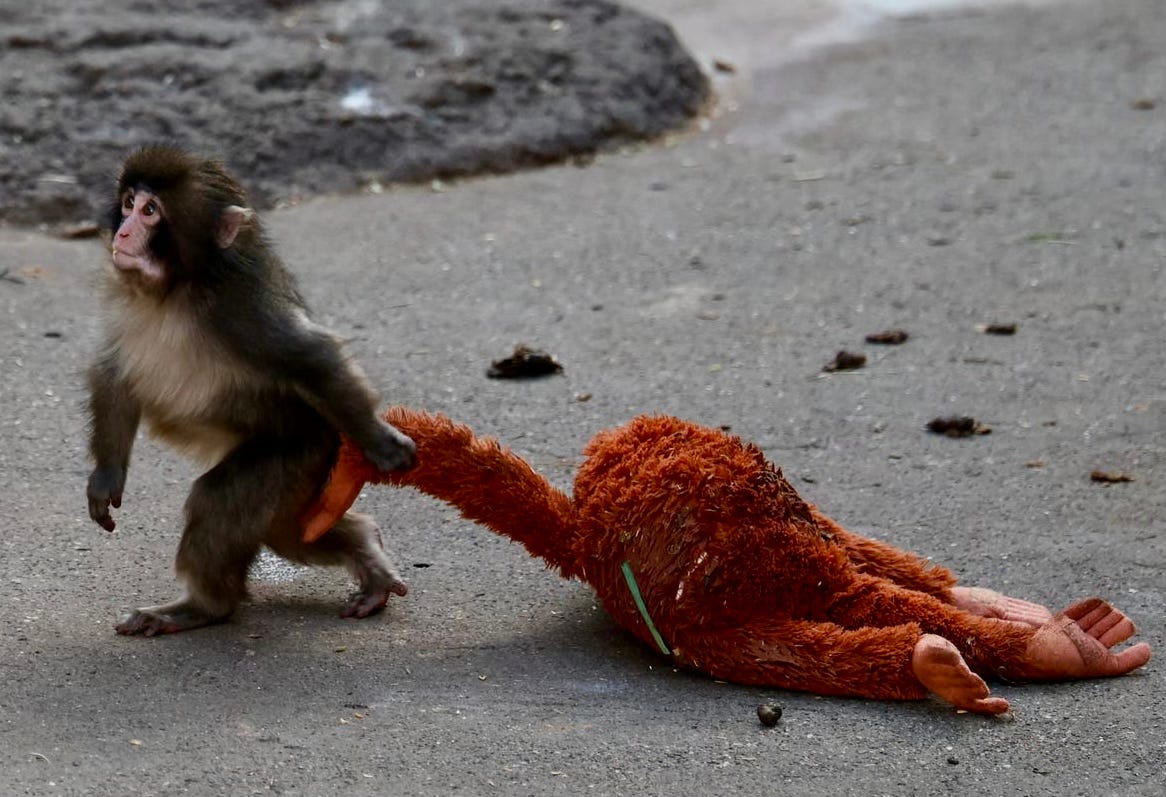
Meet Punch, a young macaque in Japan, who was rejected by his mother and given a stuffed orangutan as a surrogate. Videos show him walking upright, dragging the plush companion, sometimes waving a stick like a baton. At first, it’s adorable. At second glance, it’s neuroscience in action.
Punch’s unusual gait illustrates how brains navigate constraint: his hands are occupied, so his nervous system adapts, recruiting muscles and cortical circuits to achieve stability. He is not evolving new anatomy—he is repurposing what he already has, under motivational pressure.
This is motor plasticity made visible. His upright walking is a real-time demonstration of resilience: brains reorganizing themselves to meet environmental and emotional demands.
I explore Punch’s story and what it teaches about adaptation, motor learning, and neural flexibility in my latest Medium article: Punch the Bipedal Monkey: What a ‘Strutting’ Macaque Teaches Us About the Improvising Brain Under Constraint
For readers who want to go deeper, I’ve compiled a “For Further Reading & Viewing” list below. I’m also developing videos and an online course on brain plasticity, adaptation, and wellbeing—follow along at my website https://johnguzowski.com.
Thanks for reading!
John (aka Dr. G)
For Further Reading & Viewing
If you want to go deeper:
Attachment and Surrogate Comfort
Harlow, H. F. (1958). The Nature of Love. American Psychologist. Classic paper on contact comfort in infant rhesus monkeys.
Suomi, S. J. (1997). Early determinants of behaviour: Evidence from primate studies. British Medical Bulletin.
Kumar Maganathan, D. (2026, Feb 24). Primatologist says Punch’s story is not cute, it’s trauma. FMT Lifestyle.
Cortical Plasticity and Motor Learning
Weinberger, N. M. (2004). Specific long-term memory traces in primary auditory cortex. Nature Reviews Neuroscience, 5, 279–290. Landmark demonstration that motivated learning induces lasting, specific reorganization of cortical representational maps.
Merzenich, M. M. et al. (1983). Somatosensory cortical map changes following digit amputation in adult monkeys. Journal of Comparative Neurology.
Nudo, R. J. et al. (1996). Use-dependent alterations of movement representations in primary motor cortex. Journal of Neuroscience.
Greenough, W. T., Black, J. E., & Wallace, C. S. (1987). Experience and brain development. Child Development.
Shadmehr, R. & Krakauer, J. W. (2008). A computational neuroanatomy for motor control. Experimental Brain Research.
Visual Media
Publicly available zoo footage of Punch (search: “Punch baby macaque plush orangutan”).